Tanpura
A steady centre.
Choose Sa, pattern, register and fine tuning.
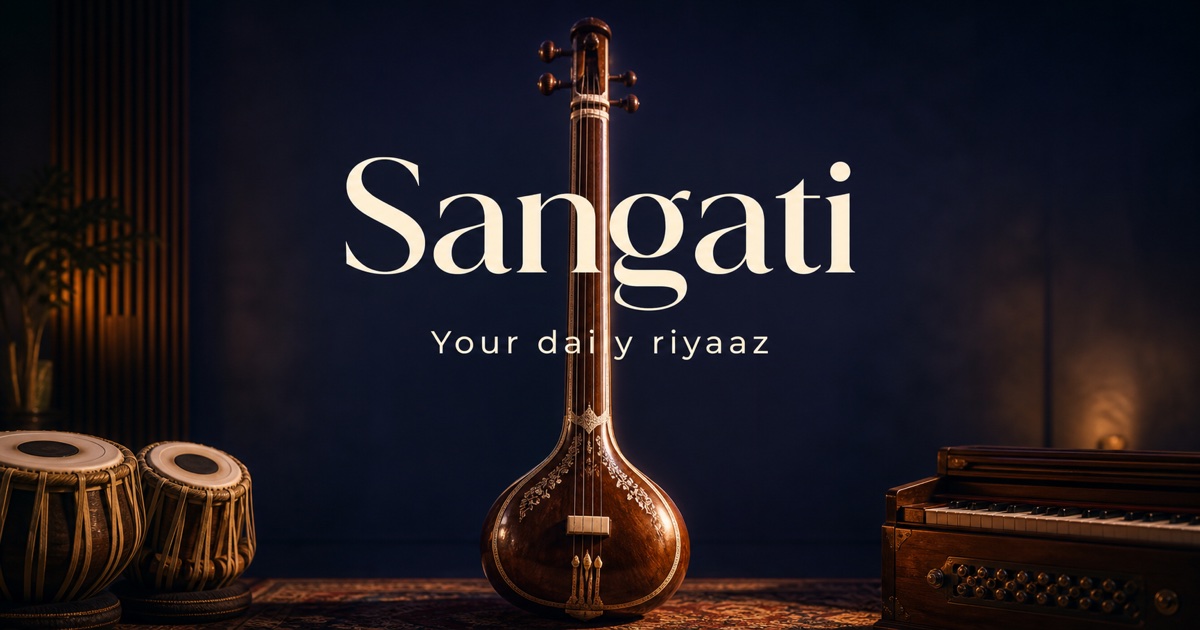
संगति · Your daily riyaaz
Tanpura, tabla, harmonium, tuner, audio recording and video recording, together on iPhone and iPad.

Listen closely.
Find your Sa.
Stay in taal.
One quiet place to practise
Tanpura
Choose Sa, pattern, register and fine tuning.
Tabla + taal
Follow sam, tali, khali, matra and theka together.
Harmonium
Responsive keys, swara labels and held drones.
Tuner + recording
Private, on-device M4A audio or MOV video takes with aligned accompaniment.
Taal library
25 complete theka references. Recorded playback is enabled only where the exact real-instrument stroke bank is verified.
Your Sa, everywhere
Tanpura, harmonium labels and tuner share the same tonic. Fine tune by cents when the room demands it.
Start free. Keep it forever.
Free
Lifetime Pro
The App Store always shows your local one-time price before purchase.
Clear by design
No account, no ads and no behavioural tracking. Read the complete policies on their own calm, accessible pages.
Audio provenance
The acoustic recordings used by Sangati are credited here, with their creators, source links, licences and changes made for playback.
Acoustic tanpura recordings 153247, 153263, 153265, 155272 and 155274 from Freesound pack 9571 ↗, licensed under CC BY 4.0 ↗. Sangati selected stable cycles, made a 750 ms loop crossfade, converted them to stereo 48 kHz / 24-bit PCM and level matched them. Playback uses the nearest approved recording of the same pattern and register. Duration-preserving pitch shifting is capped at ±4 semitones, plus up to ±50 cents of fine tuning. A transposed Sa is not a separately recorded source.
Thirty-eight recorded-note samples derive from Donya Quick's recording 330410 (Euterpea Studio, Yale University) ↗ and the edited set by Nicholaus P. Brosowsky ↗, under CC BY 3.0 ↗. F♯4 comes from cabled_mess sound 523862 ↗ under CC0 1.0 ↗. Sangati resampled and level matched that key without trimming or changing its pitch. The other 38 samples retain the edited audio published by Nicholaus P. Brosowsky, whose changes include trimming, fades, level matching, noise reduction and some pitch correction. These 39 sources cover MIDI 36–74. The keyboard offers MIDI 12–96, using the nearest recorded source with varispeed when an exact source is absent. Sustained notes crossfade a region of the selected source recording; transposed keys are not presented as separately recorded samples.
Ten original acoustic tabla recordings by Ajay Srinivasamurthy (Freesound user ajaysm), from Freesound pack 10737 ↗, licensed under CC BY 4.0 ↗. Source sounds: 171900 (Dha), 171904 (Dhin), 171902 (Ga), 171901 (Ka), 171906 (Kat), 171905 (Na), 171907 (Re), 171913 (Te), 171911 (Tin) and 171909 (Tun).
Sangati selected the original right channel, applied fixed linear level matching and short boundary fades, and encoded mono 44.1 kHz / 24-bit PCM without resampling; the originals have 16-bit source precision. Playback applies bounded level matching. There is one recorded hit per source bol, with no manufactured round-robin variants, synthesis, pitch change, layered substitute strokes, EQ or denoising. Tabla retains its recorded tuning and does not follow the selected Sa. Written Ge uses Ga, Ke/Ki uses Ka, ringing Ta uses Na, Ti uses Te, and closed Ta uses Re. These mappings do not imply that every gharana uses identical strokes.
Original source recordings: Dha ↗ · Dhin ↗ · Ga ↗ · Ka ↗ · Kat ↗ · Na ↗ · Re ↗ · Te ↗ · Tin ↗ · Tun ↗.
Seven acoustic string plucks from Tuning Swarmandal Indian Harp, Freesound 415398 ↗ by luckylittleraven, dedicated under CC0 1.0 ↗. Sangati extracted isolated plucks from the HQ MP3 preview, removed DC offset, matched fixed levels, applied boundary fades, corrected small tuning deviations and converted to stereo 48 kHz PCM. Playback transposes the nearest recorded pluck to the chosen Sa and raag notes. These sweeps provide tuning accompaniment; transposed notes are not separate source recordings.
The optional plain metronome is a generated utility click, always labelled as such and never presented as an acoustic instrument. Sangati applies safety peak limiting to playback and recording mixes. The credited source and derivative recordings are not peak-limited. No endorsement by any credited creator is implied.
Human support
Restore a purchase, report an audio issue, or tell us what your practice needs next.